“Amid all the disturbances of Fortune, he was undisturbed”
– Seneca admiring the constitution of Socrates
I’ve been reading up on the philosophy of Stoicism. No one puts the essence of the entire philosophy into better words that my favourite contemporary philosophy Alain de Botton. In the spirit of standing on the shoulders of giants I’ve shamelessly borrowed words from his book ‘The Consolations of Philosophy’ both verbatim and in adoption. And whilst there are amazing contemporary authors who write on the subject like, Ryan Holiday, Massimo Pigliucci, Donald Robertson and Jonas Salzgeber; I’ve relied solely on Alain’s work to prepare this layman’s (i.e. the author) summary.

Stoicism adopted as a personal philosophy helps us create resolution against life’s impending fortunes. While our experiences teach us a comprehensive dictionary of frustration, our wisdom and knowledge in philosophy arms us with a series of response to these frustrations.
At the heart of every frustration lies a basic structure: the collision of a wish with an unyielding reality
In life we discover that:
- Most sources of our satisfaction lie beyond our locus of control
- The world does not reliably conform to our desires
The key lessons therein would be:
- Curtail the sources of your satisfaction to within your locus of control
- Place no hope or reliance on the world to conform to our desires
In studying frustrations,we observe 2 recurring themes:
- We endure well, the frustrations we have prepared ourselves for and understand.
- We are hurt most by events we least expected and cannot fathom.
Stoicism’s task is to prepare for our wishes and hopes the softest landing possible on the hard, stone wall of reality.
The key lessons therein would be:
- Prepare yourself in advance by understanding the frustrations you might face in the future to come
The philosophy explores the two contradictory elements; emotion and reason, in our interactions with reality. To explore let’s take the emotion, ‘Anger‘ as an example.
- Reason does not always govern our actions – if we are sprinkled with cold water, our body has no choice but to shiver; if fingers are flicked over our eyes we have to blink.
- However anger/emotion does not belong to the category of involuntary physical movement – it only breaks out on the back of certain rationally held ideas.
- If we change those ideas we change our propensity to anger/feel overwhelmed by any such emotion.
- At the base of our anger/emotion are dangerously optimistic notions about what the world and other people are like
The key lessons therein would be:
- Reduce and rationalise optimistic expectations one would have about the world and other people
How badly we react to frustration is determined by what we think of as normal.
Our familiarity with bath showers means we are unlikely to ever respond to one with anger. However when we forget our umbrella at home neglecting a rain forecast we are beside ourselves…
Our frustrations are tempered by:
- What we know to expect from the world
- Our experience of what is normal to hope for
Ergo, we aren’t overwhelmed by anger/emotion whenever we are denied an object we desire; only when we believe ourselves entitled to obtain it.
We shout when we can’t find the remote control because of an implicit belief in a world in which remote controls do not get mislaid
We will cease to be so angry/overwhelmed by emotion once we cease to be so hopeful.
Reality comprises of two (confusing and contradictory) characteristics:
- Continuity and reliability lasting across generations in some occasions
- Unheralded cataclysms in some occasions
Tomorrow might be very much like today or we might face an appalling event after which nothing will ever be the same again. And since we are injured most by what we do not expect, we must hold the possibility of disaster on our minds at all times. There is a dangerous innocence in the expectation of a future formed on the basis of probability. Any accident to which a human has been subject to, however rare, or distant in time is a possibility we must be ready for. It is to this effect, that Stoicism introduces one of it’s many tools Premeditatio Malorum – a meditation in advance of all the sorrows of mind and body to which fortune might subject us to.
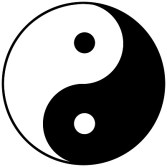
A subject’s agency is only ONE of the causal factors determining events in the course of the subject’s life. Not everything which happens to us occurs with reference to something about us. The interventions of fortune whether kindly or diabolical introduce a random element into human destiny. [symbolically depicted best by the Daoist Symbol of Ying and Yang, where chaos lies just around the corner within order and the opportunity to create order lies within every chaos]
As a result of this, we face a condition of agitation about an uncertain situation which one both wishes will turn out for the best and fears may turn out for the worst. The traditional comfort to soothe this existential angst/anxiety is re-assurance (that fears are exaggerated and things will unfold as one wishes) BUT it leaves one unprepared and unwittingly implies that things would be disastrous if the worst came to pass.
A more grounded consolation would be that: bad things may happen; however they are unlikely to ever be as bad as we fear. If you wish to put off all worry assume that what you fear may happen is certainly going to happen. Once we look rationally (during premeditatio) at what will occur once our desires are not fulfilled, we will certainly find that the underlying problems are more modest than the anxieties they have bred.
One might think that this form of thinking is defeatist or quite pessimistic. On the contrary, stoicism doesn’t say that one must put up with one’s fate and not aspire to improve matters. Explained in a contemporary quote – it’s not that you should not own things, but that the things you own should not end up owning you. It also not that we should be complacent but know when to rebel against reality.
In Seneca’s terms the truly wise are identified by one detail – how they would respond to sudden poverty/disaster; not how they would deny themselves good fortune.
- A wise man is self-sufficient… if he loses a hand through disease or war, or if some accident puts out one or both of his eyes, he will be satisfied with what is left.
- The wise man will not despise himself even if he has the stature of a dwarf but would nevertheless wish to be tall.
- The wise man is self-sufficient that he can do without friends not that he desires to do without them.
The key lessons therein would be:
- Practice contentment and being grateful for what you have at any given moment
Our frustrations have purpose. To generate the energy required to spur us to action, we are reminded by jolts of negative emotion – frustration, anxiety, pain, outrage, offence that reality is not how we wish.
However if these jolts would have served no purpose if we cannot subsequently effect improvement on our reality. As stoics we must correctly discern where we can mould/change reality according to our wishes and where we must accept unalterable reality with tranquillity. The wise will learn to identify what is necessary and follow it at once, rather than exhaust themselves in protest. It is no less unreasonable to accept something as necessary when it isn’t as to rebel against something when it is.
To sum up life in a single metaphor –
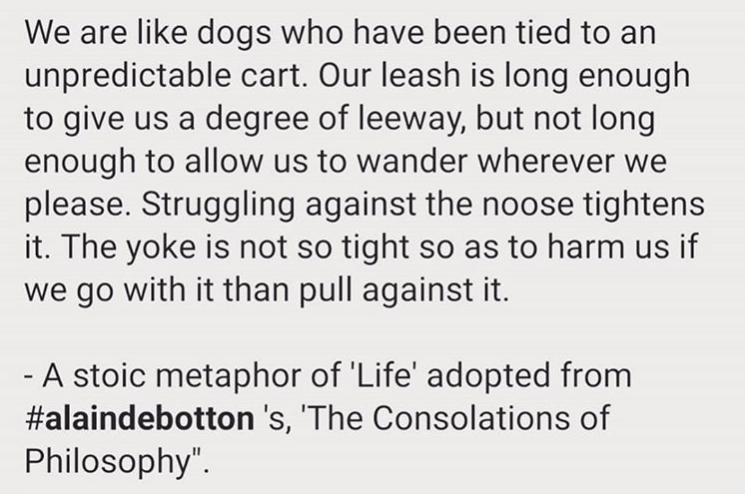
The key lessons therein would be:
- Sometimes the best thing you can do when you’ve tried everything, is to do nothing
 Musings